How Often Should Rabbits See a Vet? A Complete Guide
Annual exams for adult rabbits, twice yearly for seniors — plus the emergency signs that mean go today, and why you need a rabbit-savvy vet before you need one.
Heads up: some product links below are affiliate links, meaning we earn a small commission if you buy — at no extra cost to you. As an Amazon Associate we earn from qualifying purchases. We only link things we'd actually recommend, and nothing here is a paid placement.
Healthy adult rabbits need a veterinary check-up once a year. Seniors — roughly five years and older — should go twice a year.
The schedule, though, is the easy part. The thing that genuinely determines outcomes is this: find a rabbit-savvy vet before you need one. Rabbits count as exotics, plenty of general practices don’t treat them, and rabbit emergencies move quickly enough that “I’ll sort that out if something happens” is a genuinely dangerous plan.
Find your vet first
Rabbits are prey animals, and they conceal illness by instinct. A rabbit that looks obviously unwell has usually been unwell for a while. Combine that with a digestive system that can deteriorate within hours, and the search for a clinic is something you want to have finished in advance.
What to do this week, before anything is wrong:
- Find a regular clinic that treats rabbits. Ask directly: “Do your vets see rabbits routinely, and do you perform rabbit dentals and spays?” A practice that treats rabbits occasionally is not the same as one that treats them regularly.
- Find a 24-hour emergency option that accepts rabbits. This is frequently a different clinic, and finding out at 2am is the worst time to learn that.
- Save both numbers somewhere you can reach them fast — phone contacts, and written down where anyone in the household can find them.
- Know the drive time to each.
Good sources for finding one: House Rabbit Society vet listings, the Association of Exotic Mammal Veterinarians, local rabbit rescues (they always know who’s good), and rabbit owner groups in your area.
What a routine rabbit exam includes
A proper rabbit wellness exam is more than a quick look over. Expect:
- Weight and body condition scoring — tracked over time, which is why regular visits matter more than any single one
- Dental examination, including the back molars, which usually needs an otoscope or specialized scope. This is the part general practices most often skip.
- Ears, eyes, and nose
- Heart and lungs
- Abdominal palpation and gut sounds
- Skin and coat, including the rear end
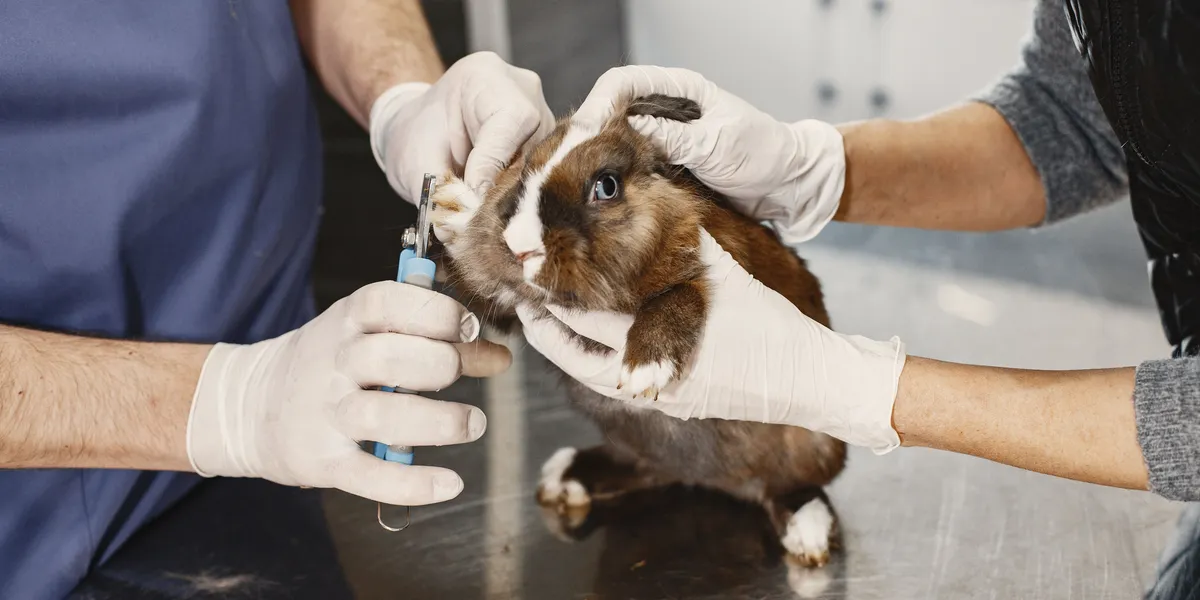
- Nail trim, usually
- A husbandry conversation — diet, enclosure, litter, exercise, and enrichment
For seniors or rabbits with specific concerns, your vet may add bloodwork, a faecal test, urinalysis, or x-rays.
Why annual exams matter more for rabbits
Skipping check-ups for an animal that appears perfectly healthy is a very easy decision to make. The veterinary data makes a strong case against it.
The VetCompass study of 6,349 rabbits in English primary care practices found the most common recorded disorders were:
| Disorder | Prevalence |
|---|---|
| Overgrown nails | 16% |
| Overgrown molars | 7.6% |
| Perineal soiling | 4.5% |
| Overgrown incisors | 4.3% |
| Ileus (gut slowdown) | 4.2% |
Look at that list properly. Almost all of it is invisible from your living room and completely routine for a vet to catch. You cannot see your rabbit’s back molars — nobody can, without an instrument. Gradual weight loss is invisible precisely because it’s gradual. And perineal soiling is easy to overlook right up until it becomes the flystrike risk that kills, which is the single largest recorded cause of death in that same study.
Dental disease in particular is progressive and much cheaper and kinder to manage early than late. See how long do rabbits live for what that data says about lifespan.
The schedule by life stage
Young rabbit (under 1 year): an initial check after adoption, then vaccination and spay/neuter appointments as appropriate.
Adult (1–5 years): annually. Add visits for any concern.
Senior (5+, or earlier for giant breeds): twice a year. Ageing rabbits develop arthritis, dental problems, kidney disease, and tumours, and six months is a long time in a small animal’s decline.
Spaying and neutering
Usually the largest veterinary expense of a rabbit’s first year, and one of the highest-value.
Typical timing: males around 3–5 months, once the testicles have descended; females around 4–6 months, varying by breed, size, and health. Your vet will advise for your individual rabbit.
Why it matters medically: uterine adenocarcinoma is the most common tumour in female rabbits, with commonly cited veterinary estimates around 60% of unspayed does over age three. Spaying removes that risk. The same research programme found unspayed females were 3.3 times more likely to suffer flystrike than spayed ones.
Why it matters behaviorally: intact rabbits spray, are more territorial and aggressive, and are much harder to litter train. It also makes bonding a second rabbit realistic — two intact rabbits generally can’t live together safely.
Vaccinations: check locally, because this changes
Vaccination is the most region-dependent part of rabbit care, and the guidance genuinely changes. Treat the below as orientation and confirm the current protocol with your own vet.
In the UK, rabbits are routinely vaccinated against myxomatosis and rabbit haemorrhagic disease (RVHD1 and RVHD2). Rabbits can be vaccinated from around five weeks old. Notably, the RWAF updated its advice recently in response to a highly virulent RVHD2 strain identified in continental Europe, and now recommends two vaccinations a year — the annual triple vaccine plus a separate vaccine for the new strain, given at least two weeks apart.
In the US, the picture is different. RHDV2 has caused outbreaks in wild and domestic populations, and a vaccine from Medgene holds a conditional USDA license — the only one currently permitted for veterinary use. It’s given by a veterinarian as a two-dose course, and availability and rules vary considerably by state, with some states imposing specific requirements.
The takeaway: ask your vet what’s recommended where you live, and re-ask periodically. The fact that UK guidance changed in the last couple of years is precisely the point.
Emergency signs: go today
These warrant a same-day call, including out of hours. Do not wait and see.
- Not eating, or a marked drop in appetite — see why is my rabbit not eating
- No droppings, or much smaller/fewer droppings
- Loud, slow tooth grinding — a pain signal, distinct from soft contented tooth purring. See why is my rabbit grinding its teeth
- Hunched posture, pressing the belly to the floor, or unwillingness to move
- Laboured or open-mouth breathing — rabbits are obligate nose breathers, so this is serious
- Head tilt or loss of balance
- Sudden lethargy or collapse
- Seizures
- Maggots or fly eggs anywhere on the rabbit — flystrike is a true emergency and progresses within hours
- Straining to urinate, or blood in urine
- Bleeding, or any suspected fracture — especially after a fall or a struggle while being held
- Dragging or paralysed hind legs
- Overheating — rabbits tolerate heat poorly
A rabbit that hasn’t eaten and hasn’t produced droppings for around 12 hours needs to be seen that day. This isn’t over-caution; gut stasis compounds quickly.
Signs that mean book an appointment soon
Less urgent, but don’t let these drift:
- Gradual weight loss or gain
- Drooling, or a wet chin and dewlap
- Dropping food while eating, or preferring soft foods
- Runny eyes or nose, sneezing
- Persistent soft stool or uneaten cecotropes
- Changes in litter box habits
- Reduced grooming, or a scruffy coat
- Lumps or swellings
- Limping or stiffness
- Reduced activity, or less interest in a bonded partner
Preparing for the visit
- Use a hard-sided carrier that opens from the top, lined with familiar bedding and some hay.
- Bring a bonded partner along if you have one, even if only one is sick. It reduces stress and prevents the pair rejecting each other on return because one smells like a clinic.
- Bring a recent dropping sample, and photos or video of anything intermittent.
- Write down symptoms and dates in advance — it’s easy to forget details in the room.
- Bring the food you feed, or a photo of the packaging, for the husbandry conversation.
- Don’t fast a rabbit before a procedure unless your vet specifically instructs it. Rabbits can’t vomit, so pre-anaesthetic fasting is generally unnecessary and can be harmful.
What it costs, and planning for it
Exotic care generally costs more than equivalent cat and dog care — there are fewer practitioners, and rabbit medicine is more specialized.
Budget for four things: the annual exam, spay or neuter in year one, vaccinations where applicable, and an emergency fund. That last one matters most. GI stasis, dental surgery, and flystrike all require prompt treatment, and the worst position to be in is choosing between a rabbit’s life and a bill you can’t cover.
Pet insurance covering exotics exists and is worth pricing. Some rescues and welfare organizations run low-cost spay/neuter clinics.
Frequently asked questions
Do indoor rabbits need vaccinations? In regions where rabbit haemorrhagic disease is present, yes — RHDV is extremely hardy and can be carried indoors on clothing, shoes, hay, and by insects. Ask your vet about local risk.
How do I know if a vet is genuinely rabbit-savvy? Ask how many rabbits they see, whether they perform rabbit dentals and spays, whether they examine back molars routinely, and what their anaesthetic protocol for rabbits is. Confident, specific answers are the signal.
My rabbit seems perfectly healthy. Can I skip the annual exam? This is the reasoning the disorder data argues against. Rabbits mask illness, and most of the common problems are ones an owner can’t see. The annual visit also builds a weight and dental history, which is what makes future changes obvious.
Can my regular cat and dog vet see my rabbit? Sometimes, but verify rather than assume. Rabbit anaesthesia and dentistry differ meaningfully from cat and dog practice.
How often do rabbits need their nails trimmed? Roughly every 4–8 weeks. You can learn to do it at home with a pair of small-animal nail clippers, and overgrown nails were the single most common disorder in the veterinary data.
Book the annual exam, put both clinic numbers in your phone today — genuinely, today — and learn the same-day list above. Most rabbit emergencies are survivable when caught early, and catching them early is very largely a matter of already knowing where you’re going.
Sources: O’Neill DG et al., Morbidity and mortality of domestic rabbits under primary veterinary care in England, Veterinary Record, 2020; Rabbit Vaccinations Guide, Rabbit Welfare Association & Fund; Rabbit hemorrhagic disease, American Veterinary Medical Association.
← All posts