What Vegetables Can Rabbits Eat? A Safe Foods List
Safe leafy greens, herbs, and vegetables for rabbits, how much to feed by body weight, and which greens to rotate rather than feed daily.
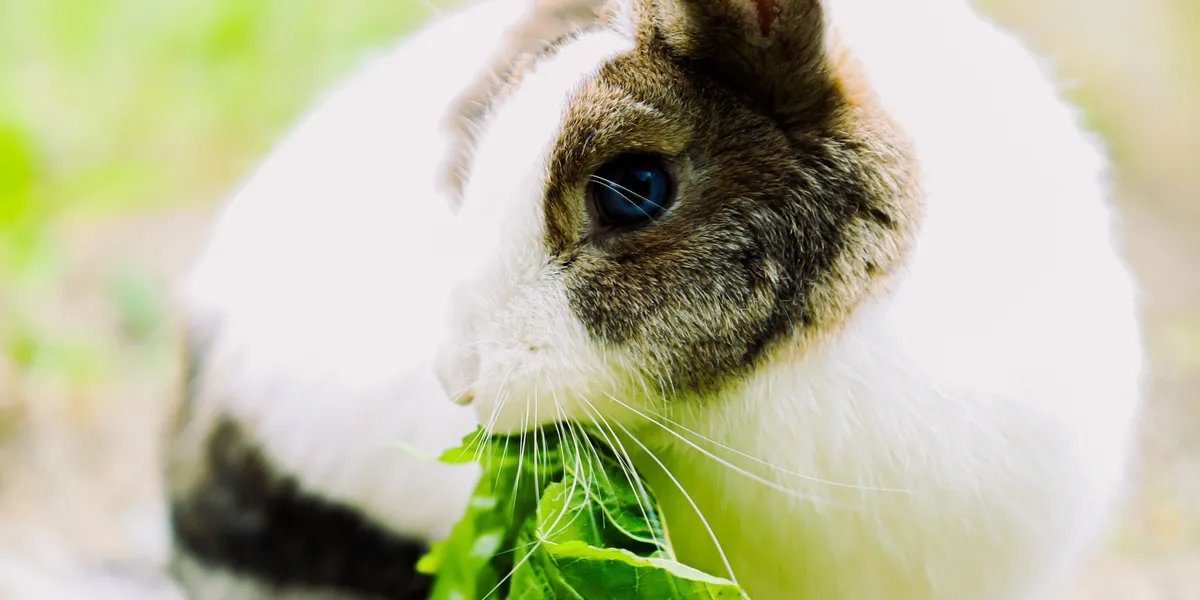
Fresh greens should make up about 10% of your rabbit’s diet — roughly 1 to 2 cups per 4 lb of body weight daily, per House Rabbit Society guidance. Hay is still the foundation; greens are the daily supplement that adds variety, moisture, and micronutrients.
The single most useful rule here is unglamorous: rotate. Most green-related problems don’t come from feeding something dangerous. They come from feeding one perfectly good green, exclusively, every single day, forever.
How much to feed
| Rabbit weight | Daily greens |
|---|---|
| 2 lb (0.9 kg) | ½–1 cup |
| 4 lb (1.8 kg) | 1–2 cups |
| 6 lb (2.7 kg) | 1½–3 cups |
| 8 lb (3.6 kg) | 2–4 cups |
| 10 lb (4.5 kg) | 2½–5 cups |
Split it across two meals if you can. Aim for three or more different types in rotation rather than a big pile of one thing.
Everyday leafy greens
These are low enough in oxalates and calcium to feed daily. Build the bulk of your rotation from this list:
- Romaine lettuce — the reliable staple
- Green leaf and red leaf lettuce
- Bok choy
- Endive and escarole
- Watercress
- Arugula
- Carrot tops — the leafy part is better for rabbits than the carrot
- Cilantro
- Basil
- Dill
- Mint
Herbs deserve their own mention: they’re reliably the biggest hit with fussy rabbits, and cilantro in particular has converted more picky eaters than anything else on this list. If your rabbit is refusing greens, start there.
Greens to rotate, not feed daily
This is where most confusion lives, so it’s worth being precise. Two different concerns get merged into one vague warning:
High in oxalates — spinach, parsley, mustard greens, beet greens, chard, radish tops. Excess dietary oxalate can contribute to calcium oxalate stones in the kidneys and bladder.
High in calcium — kale, collard greens, dandelion greens. Rabbits absorb calcium differently from most mammals, and a persistently high-calcium diet can contribute to bladder sludge — thick, chalky urine that can progress to stones.
Kale is not spinach
Kale has taken on a reputation it doesn’t quite deserve, because it gets grouped with spinach in “limit these” lists. Spinach contains roughly 80 times the oxalates that kale does. They are not the same risk.
Kale’s consideration is calcium, not oxalate — and fresh kale is 70–85% water, which dilutes everything in it. A few kale leaves a couple of times a week, as part of a varied rotation, is not the problem it’s often made out to be.
The practical takeaway for both categories is the same, and it isn’t “never feed these”:
- Keep high-oxalate greens like spinach and parsley to roughly two or three times a week, in small amounts.
- Alternate them with low-oxalate greens rather than stacking them on the same day.
- Never make any one of them the everyday staple.
Vegetables in moderation
Leafy greens should lead. These are fine as smaller additions:
- Bell pepper (remove seeds and stem)
- Celery — cut into short pieces so the strings don’t cause issues
- Zucchini and summer squash
- Cucumber — very watery, so a small amount
- Broccoli leaves and stems — can cause gas in some rabbits; introduce cautiously
- Brussels sprout leaves — same caution
Carrots are a treat, not a vegetable staple. They’re high in sugar. Feed the tops instead if you want the daily option. See what are good rabbit treats.
Fruit is a treat, not a fresh food
Apple (no seeds), banana, berries, and melon are all fine — in thumbnail-sized portions, a couple of times a week at most. Fruit sugar reaching the hindgut is the same mechanism that makes processed carbs a problem for rabbits.
What not to feed
Some of these are genuinely toxic, others are simply unsuitable:
- Onion, garlic, leeks, chives — the allium family is toxic
- Avocado — toxic
- Rhubarb leaves — high oxalic acid
- Potato, tomato leaves and stems — nightshade foliage
- Corn, beans, peas — starchy, poorly digested
- Iceberg lettuce — not toxic, but nutritionally near-empty and mostly water
Full detail, including what to do if your rabbit eats something it shouldn’t: foods you should never give a rabbit.
Foraging: free food your rabbit will love
Some of the best fresh food for rabbits grows wild, costs nothing, and is closer to what they’d naturally eat than anything in a supermarket.
Commonly foraged and rabbit-safe:
- Dandelion — leaves and flowers both. A perennial favourite, and rich in vitamins A, C and K plus calcium and iron. High in calcium, so rotate rather than feeding daily in quantity.
- Bramble and blackberry leaves — fibrous, well tolerated, and often recommended for rabbits with sensitive digestion. Strip the thorns.
- Plantain (the lawn weed, not the banana) — grows almost everywhere and is well liked.
- Clover — safe and popular, but high in protein, so a supplement rather than a staple.
- Chickweed
- Nettle — rabbits are unbothered by the sting. Wear gloves to pick it.
- Thistle and shepherd’s purse
Foraging safely
The plant matters less than where it grew:
- Never pick beside roads or where cars park — traffic pollution settles on the leaves.
- Avoid anywhere that may be sprayed with weedkiller or pesticide, including park edges, verges, and field margins.
- Avoid ground fouled by animals. The dandelion by the lamppost at the park has been watered by a lot of dogs.
- Be certain of the identification. If you can’t name it confidently, don’t pick it. Several toxic plants resemble edible ones.
- Wash thoroughly — a soak in cool water with a splash of white vinegar loosens debris, followed by a good rinse and a shake dry.
- Introduce gradually, exactly as you would any new food.
Never use lawnmower clippings. They begin fermenting almost immediately and can cause serious digestive upset. Hand-picked grass from an untreated lawn is fine; a bag of cuttings is not.
Growing your own
A windowsill pot of herbs is the cheapest ongoing supply of rabbit greens there is. Cilantro, basil, parsley, mint, and dill all grow readily indoors and can be cut repeatedly.
Herbs also solve the variety problem — rotating five herbs is easier and cheaper than buying five different lettuces that spoil before they’re used.
If you grow outdoors, keep rabbit-destined plants away from anything you treat, and remember that much of a typical garden — bulbs, ornamental shrubs, most flowering plants — is toxic. See foods you should never give a rabbit.
Introducing new foods safely
Rabbit guts don’t handle sudden change well. The method matters as much as the food:
- Introduce one new food at a time.
- Start with a small amount — a single leaf is plenty.
- Wait two or three days before adding anything else.
- Watch the droppings. Soft stool means back off and remove that item.
- Reintroduce later in a smaller quantity, or skip it.
A rabbit that’s never had greens — a young rabbit, or one from a pellet-only home — needs this done especially slowly, over weeks rather than days.
Washing, prep, and storage
- Wash everything thoroughly, including produce sold pre-washed.
- Serve fresh and damp — a little residual water is a bonus for hydration.
- Don’t feed wilted or slimy greens. If you wouldn’t eat it, don’t serve it.
- Remove uneaten greens within a few hours so they don’t spoil in the enclosure.
- Skip grass clippings entirely. Lawnmower clippings ferment quickly and can cause serious digestive upset. Hand-picked grass from an untreated lawn is fine.
Frequently asked questions
What vegetables can rabbits eat every day? Romaine and other dark leaf lettuces, bok choy, endive, escarole, watercress, arugula, carrot tops, and most fresh herbs. Rotate several rather than relying on one.
Can rabbits eat spinach? Yes, but sparingly — it’s very high in oxalates. A leaf or two, two or three times a week, as part of a rotation.
Can rabbits eat kale? Yes. Kale is far lower in oxalates than spinach and its main consideration is calcium. A few leaves a couple of times a week within a varied diet is fine.
Can baby rabbits eat vegetables? Introduce greens slowly and one at a time as they mature. Young rabbits have more sensitive digestion, so the gradual approach matters even more.
Why does my rabbit have soft or mushy droppings? Most often too much fresh food introduced too quickly, or too many pellets and treats crowding out hay. Cut back to hay plus one known-safe green and reintroduce slowly. If it persists, or your rabbit is off its food, see a vet — start with why is my rabbit not eating.
Do rabbits need vegetables at all? Hay and water are the non-negotiables. Greens add real variety, hydration, and micronutrients, and are strongly recommended — but a rabbit refusing greens still needs unlimited hay above all else.
Rotate three or more greens, keep the high-oxalate ones occasional, and introduce anything new slowly enough to be boring. For how greens fit alongside hay and pellets, see what should my rabbit eat.
← All posts