What Should My Rabbit Eat? A Complete Diet Guide
The 85/10/5 rule for rabbit diets, with daily hay, greens, and pellet amounts by body weight — and why hay matters far more than anything in a bag.
Heads up: some product links below are affiliate links, meaning we earn a small commission if you buy — at no extra cost to you. As an Amazon Associate we earn from qualifying purchases. We only link things we'd actually recommend, and nothing here is a paid placement.
A healthy adult rabbit’s diet breaks down like this:
- 85% grass hay — unlimited, available at all times
- 10% fresh leafy greens — daily
- 5% plain pellets — a measured portion, not a bowl to fill
Both the House Rabbit Society and the Rabbit Welfare Association & Fund independently arrive at those same proportions. It’s about as close to consensus as rabbit care gets.
The headline, which is faintly annoying if you’ve just spent money in a pet shop: the cheapest thing on the list matters most, and the expensive thing in the branded bag matters least. Nearly every diet problem in pet rabbits comes from that ratio being upside down.
Why hay does the heavy lifting
Hay looks like filler. It is the opposite of filler — it’s doing two jobs nothing else can do.
It keeps the gut moving. A rabbit’s digestive system is built to process a near-constant stream of fiber. When fiber intake drops, the gut slows, gas builds, and the rabbit feels unwell and eats less — which slows the gut further. That spiral is GI stasis, and it’s the most common rabbit emergency there is.
It wears the teeth down. Rabbit teeth grow continuously for life. Grinding through hay side-to-side is what keeps them at a workable length. Pellets don’t do this — they’re chewed too quickly and crushed rather than ground. A rabbit on a pellet-heavy, hay-light diet is a rabbit heading for dental disease.
That’s why “unlimited hay” isn’t a vague suggestion. As the RWAF puts it, you can’t give a rabbit too much hay.
How much hay is enough?
A pleasingly concrete benchmark from the House Rabbit Society: a pile of hay roughly the size of your rabbit, every day. Yes, really. Plenty of rabbits get through more, which is entirely fine.
They should never run out. If the hay rack is empty when you come down in the morning, yesterday’s portion was too small.
Which hay to buy
For healthy adults, use grass hay:
- Timothy — the standard, widely available
- Orchard grass — softer, good for fussy eaters or dusty-hay sensitivities
- Meadow hay — varied texture, good for enrichment
- Oat hay — coarser, usually mixed in rather than fed alone
Rotating two or three types keeps things interesting and covers a rabbit that goes off one kind.
Buy in bulk. Pet-store bags cost dramatically more per pound than a box from a hay supplier or a bale from a feed store — a 20 lb box of second-cutting timothy works out far cheaper per pound than the small bags, and hay keeps well if stored somewhere dry and airy.
Alfalfa is not a grass hay
Alfalfa is a legume, and it’s much higher in calcium, protein, and calories.
It’s appropriate for young, pregnant, nursing, or underweight rabbits. For a healthy adult it’s too rich — the House Rabbit Society describes it as too calorie-dense and too high in calcium.
Most rabbits transition from alfalfa to grass hay somewhere around 7 months to a year. Make the switch gradually over one to two weeks, mixing the new hay in, to avoid digestive upset or the rabbit simply refusing the unfamiliar food.
Daily amounts by body weight
Hay is unlimited. Greens and pellets are the parts you actually measure.
| Rabbit weight | Daily greens | Daily pellets |
|---|---|---|
| 2 lb (0.9 kg) | ½–1 cup | ~14 g |
| 4 lb (1.8 kg) | 1–2 cups | ~27 g |
| 6 lb (2.7 kg) | 1½–3 cups | ~41 g |
| 8 lb (3.6 kg) | 2–4 cups | ~54 g |
| 10 lb (4.5 kg) | 2½–5 cups | ~68 g |
Greens follow the House Rabbit Society’s guidance of 1–2 cups per 4 lb of body weight. Pellets follow the RWAF’s 15 g per kg. A common kitchen shorthand for pellets is about ¼ cup per 5–6 lb rabbit — close enough if you don’t have a scale, though weighing is more accurate since pellet density varies by brand.
Fresh greens
Aim for variety rather than one green fed exclusively — different plants bring different nutrients, and rotation reduces the risk of overdoing any single compound.
Good daily options include romaine and other dark leaf lettuces, cilantro, basil, parsley, dill, mint, bok choy, and watercress. Full lists and portioning are in fresh foods that are good for your rabbit.
Introduce anything new one item at a time, in a small amount, and wait a couple of days before adding another. If you see soft stool, back off. Rabbit guts don’t handle sudden change well.
Pellets: a supplement, not a meal
Buy plain, uniform, timothy-based pellets. That’s it — Oxbow Essentials adult rabbit food is the widely available example of what you’re looking for: uniform green pellets, nothing colourful mixed in.
Avoid muesli-style mixes — the colorful blends with seeds, dried corn, and puffed bits. Rabbits selectively eat the sweet, starchy pieces and leave the fibrous pellets behind, which is precisely backwards and is strongly associated with dental and digestive disease.
Pellets exist to cover nutritional gaps, not to be the main course. A rabbit that fills up on pellets eats less hay, and hay is the part doing the work. If your rabbit is ignoring hay, cut pellets back before anything else.
Water
Fresh water daily, and use a bowl rather than a sipper bottle. A heavy ceramic bowl is hard for a rabbit to tip, which is the main failure mode of lighter dishes. Research consistently finds rabbits drink more from open bowls than from bottles, and drinking from a bowl matches their natural lapping posture instead of requiring them to crane sideways at a metal spout.
Hydration is not a minor detail — low water intake contributes directly to the gut slowdown that causes stasis. Heavy ceramic bowls resist tipping.
Treats
Treats should be a very small share of the diet — under 5%, alongside the pellets.
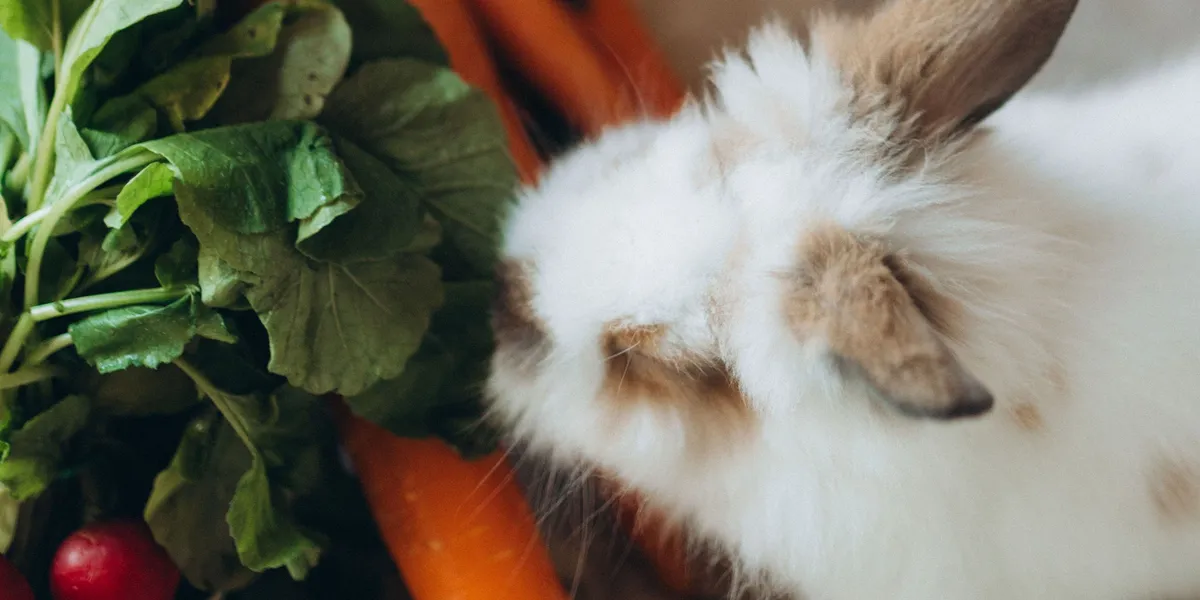
Best options are fresh herbs, a small piece of bell pepper, or a thumbnail-sized piece of fruit a couple of times a week. Carrots are a treat, not a staple — they’re high in sugar, and the cartoon image has done real damage to rabbit diets.
Skip yogurt drops, seed sticks, honey bars, and anything with added sugar or dairy. See what are good rabbit treats and foods you should never give a rabbit.
The part nobody warns you about: cecotropes
Rabbits produce two kinds of droppings.
The familiar ones are the dry, round, odorless pellets you scoop from the litter box. The others are cecotropes — softer, darker, clustered, shinier — produced in the cecum and packed with nutrients and B vitamins that the rabbit couldn’t absorb the first time through.
Rabbits eat cecotropes directly, usually straight from the source. This is normal, necessary nutrition, not a behavioral problem, and you often won’t see it happen because it typically occurs at night or early morning.
What matters for you:
- Seeing your rabbit do this is healthy, not a sign of something wrong.
- Uneaten cecotropes squashed around the enclosure usually mean a diet too rich in pellets or sugar, or a rabbit too overweight or arthritic to reach. Worth a diet review and a vet conversation.
A simple daily routine
Morning: refill hay, fresh water, half the day’s greens, measured pellets. Evening: top up hay, second half of the greens, scoop the litter box. Weekly: full litter change, check weight and body condition.
The litter box scoop is also your health check — the size and number of droppings tell you how well the gut is running. A noticeable drop, or none at all, is a same-day vet call. See why is my rabbit not eating.
How the diet changes with age
Under ~7 months: alfalfa hay and alfalfa-based pellets, generally unrestricted, to support growth. Introduce greens gradually.
Adult: the 85/10/5 diet above, on measured pellets.
Senior (roughly 5+): largely unchanged, but watch weight in both directions. Thin seniors may need more pellets or a return to some alfalfa; arthritic rabbits may need hay and water placed within easier reach.
Frequently asked questions
How much hay does a rabbit need per day? Unlimited, with a pile roughly the size of the rabbit as a practical daily benchmark. They should never run out.
Can rabbits live on pellets alone? No. A pellet-only diet leads to dental disease and gut problems, because it provides neither the fiber volume nor the grinding chew that hay does.
Why won’t my rabbit eat hay? Usually too many pellets or treats. Cut those back first. If a rabbit that previously ate hay stops, that can indicate dental pain — see why is my rabbit grinding its teeth.
Do rabbits need vitamins or supplements? Not on a proper diet. Salt and mineral licks are unnecessary.
How do I switch my rabbit’s food safely? Slowly — mix old and new over one to two weeks, and watch droppings throughout. Abrupt changes are a common trigger for digestive upset.
If you take one thing from all of this: fill the hay rack first, and measure everything else. Almost every common rabbit diet problem is some version of that one ratio being the wrong way round.
Sources: Rabbit Diet & Nutrition, House Rabbit Society; What to feed pet rabbits, Rabbit Welfare Association & Fund.
← All posts