Healthy Rabbit Treats: What to Give and What to Skip
Safe treats for rabbits with portion sizes by body weight, which pet store treats to avoid, and why papaya tablets do not do what the packaging implies.
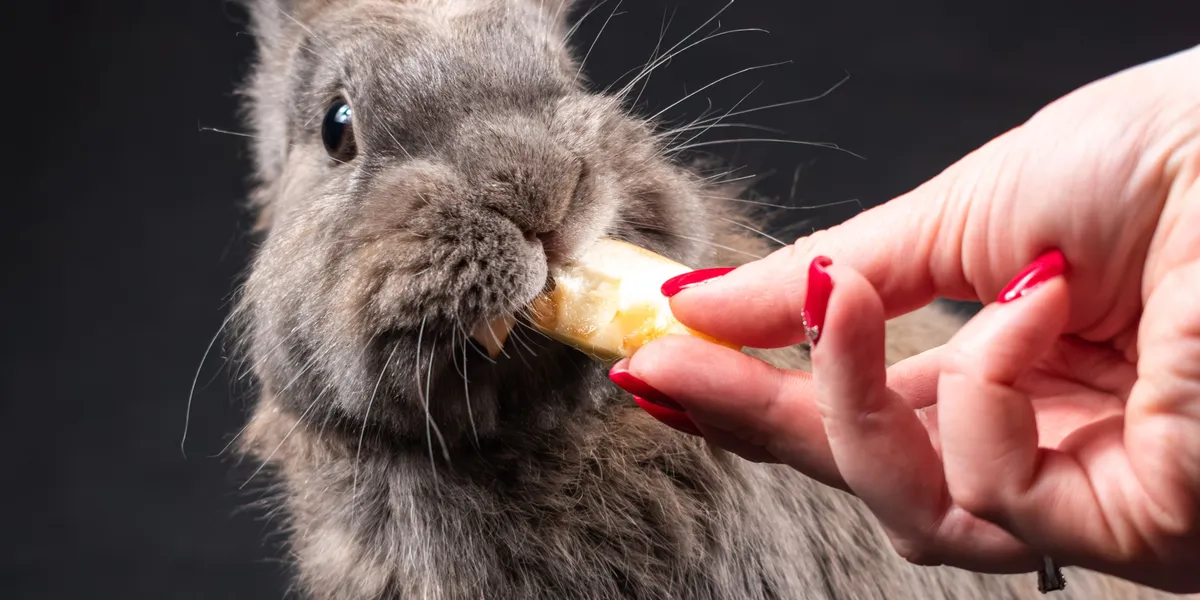
The best rabbit treats are fresh herbs — cilantro, basil, mint, parsley, dill. Low in sugar, wildly popular with the target audience, and you can hand-feed them daily without doing any harm. A single leaf of cilantro will buy you more goodwill than anything sold in a bag with a cartoon rabbit on it.
Everything else needs portion control. Treats and pellets together should stay within about 5% of the total diet, and for fruit specifically the House Rabbit Society suggests roughly 1 teaspoon per 2 lb of body weight per day as a ceiling.
That is dramatically less than most people give, and considerably less than your rabbit will argue for.
Why portion size matters more than the specific treat
Rabbits run a hindgut fermentation system that depends on a stable bacterial population. Sugar and starch that reach the hindgut feed the wrong bacteria, and that imbalance can escalate into serious gut trouble — including the motility shutdown known as GI stasis.
So the question isn’t usually “is this treat toxic?” It’s “how much sugar am I adding to a digestive system built for fiber?” A rabbit filling up on treats also eats less hay, which compounds the problem from the other direction.
Best everyday treats
These are safe to hand-feed regularly:
- Fresh herbs — cilantro, basil, mint, dill, oregano
- A leaf of something special — a different lettuce than usual, or watercress
- Bell pepper — a small strip, seeds removed
- Carrot tops — the greens, rather than the carrot
- A sprig of untreated grass, hand-picked
Here’s the useful trick with a food-motivated rabbit: novelty reads as reward. A green they don’t usually get lands as a treat even though it’s nutritionally identical to the greens they get every day. You can exploit this shamelessly.
Fruit: portions by body weight
Fruit is fine, in genuinely small amounts.
| Rabbit weight | Max fruit per day |
|---|---|
| 2 lb (0.9 kg) | ~1 tsp |
| 4 lb (1.8 kg) | ~2 tsp |
| 6 lb (2.7 kg) | ~1 tbsp |
| 8 lb (3.6 kg) | ~4 tsp |
| 10 lb (4.5 kg) | ~5 tsp |
Many owners choose to give fruit only once or twice a week rather than daily, which is a reasonable and more conservative approach.
Good choices: apple (seeds removed), banana, blueberries, raspberries, strawberry, melon, pear.
Dried fruit is roughly three times as concentrated as fresh, so the portion has to shrink accordingly. A tablespoon of dried banana chips is not the same as a tablespoon of banana — this is one of the easiest ways to accidentally overdo sugar.
Store-bought treats: what to look for
Read the ingredient list, not the front of the bag. Rabbit packaging is marketed to humans.
Reasonable choices:
- Plain dried herbs and flowers (chamomile, marigold, dandelion)
- Compressed hay cubes
- Plain timothy-based treats with no added sugar
- Untreated willow, apple, or hazel chews
A good rule: if you can’t identify every ingredient as a plant a rabbit would recognize, put it back.
Store-bought treats to avoid
- Yogurt drops. Sold everywhere, in nearly every rabbit aisle. Rabbits are strict herbivores and don’t handle dairy, and these are mostly sugar. There is no version of this product that’s appropriate.
- Seed and nut sticks. High fat, and the honey-bound ones add sugar on top.
- Honey or molasses bars.
- Anything with added sugar, corn syrup, or dairy.
- Muesli-style mixes sold as “treats” — same selective-feeding problem as muesli food.
- Salt and mineral licks. Unnecessary on a proper diet.
About papaya and pineapple tablets
These are sold specifically as a hairball remedy, and the implied mechanism — enzymes that dissolve swallowed fur — is worth examining, because it doesn’t hold up.
Enzymes do not dissolve hair. Not papaya’s papain, not pineapple’s bromelain, not pancreatic enzymes. Hair is keratin, and these enzymes don’t break it down. Some sources suggest they may help break down the mucus matrix binding a mass together, which is a much more modest claim, and the evidence for real-world benefit is mixed. The House Rabbit Society has collected owner reports suggesting benefit while acknowledging there’s no hard evidence.
It’s also worth reframing the problem. Rabbits groom themselves and swallow fur constantly, and they cannot vomit, so it has to pass through. When it doesn’t, the underlying issue is almost always slowed gut motility — not a cat-style hairball sitting there needing to be dissolved.
What actually prevents fur-related blockages:
- Unlimited grass hay. Fiber keeps the gut moving, which moves fur along with everything else.
- Water intake. Use a bowl rather than a bottle.
- Brushing during molts, so there’s less loose fur to swallow in the first place. See why is my rabbit losing fur.
So: papaya tablets are fine as a treat — they’re dried fruit, so count them against the sugar budget. Just don’t buy them as insurance, and definitely don’t increase them during a molt thinking you’re preventing a blockage. You’d be adding sugar while believing you’re adding protection.
Using treats well
Treats are genuinely useful beyond making your rabbit happy:
- Building trust. Hand-feeding is the fastest route to a nervous rabbit deciding you’re safe. See how to bond with your rabbit.
- Training. Rabbits learn targets, recall, and carrier entry readily with food motivation.
- Carrier and vet cooperation. A rabbit that associates the carrier with treats is far easier to transport.
- Medication. A willing eater is much simpler to medicate.
Use small pieces. A treat’s value to a rabbit is about the event, not the volume — a single herb leaf works as well as a whole handful.
Training with treats
Rabbits are considerably more trainable than their reputation suggests, and food is how you do it. They learn by association, quickly, and they never respond to correction — so treats aren’t a bribe, they’re the entire mechanism.
Things worth teaching:
- Coming when called. Say the name, produce a herb, repeat. Most rabbits pick this up in days, and it’s genuinely useful when you need to locate a free-roaming rabbit.
- Going into the carrier. Feed treats inside the carrier daily with the door open, so it becomes a good place rather than a warning of a vet trip. This single habit removes most of the stress from veterinary visits — see do rabbits like to be held.
- Target training. Teach your rabbit to touch its nose to a stick or your finger for a treat, then use it to guide them where you want without handling.
- Going back into the pen on cue, rather than being chased around the room.
- Standing up or spinning, which is pure entertainment but builds engagement.
How to do it: tiny pieces, immediate reward, short sessions of a few minutes, and always finish while your rabbit is still interested. Never punish a wrong answer — just don’t reward it.
Because you’re working with a daily treat budget, use herb leaves torn small rather than fruit. A single cilantro leaf is a complete reward as far as a rabbit is concerned.
Treats and medication
Sooner or later your rabbit will need medicating, and a rabbit with positive food associations is dramatically easier to treat.
- Many oral medications can be mixed into a small amount of something palatable — check with your vet first, since some drugs shouldn’t be given with food.
- A rabbit that trusts hand-fed food will often take a syringe more willingly, because syringes and good things are already linked.
- Practise in advance. Offering water or a little diluted fruit from a syringe occasionally, while nothing is wrong, means the syringe isn’t a novel threat during an illness.
That last point matters more than it sounds. When a rabbit is genuinely unwell, appetite is already compromised, and a fight over medication is the last thing either of you needs.
Treats for an overweight rabbit
Obesity is common in pet rabbits and carries real consequences — it contributes to the grooming failures behind flystrike and to sore hocks, and makes it harder for a rabbit to reach its cecotropes.
If your rabbit needs to lose weight, treats are the first thing to cut, not hay:
- Remove fruit and any commercial treats entirely for a while
- Keep herbs, which are low in sugar and preserve the bonding and training uses
- Cut pellets back before touching hay
- Never restrict hay — it’s the one thing that should stay unlimited
- Use foraging enrichment so the reduced food takes longer to eat
Frequently asked questions
Can rabbits eat carrots? Yes, as an occasional treat. Carrots are high in sugar, and the cartoon association has led a lot of people to feed them as a staple. The tops are the better everyday option.
What treats can baby rabbits have? Go very light. Young rabbits have sensitive digestion, and their priority is unlimited hay and appropriate pellets. Introduce herbs slowly and skip fruit early on.
Are yogurt drops really that bad? Yes. Dairy plus concentrated sugar is close to the worst combination for a rabbit’s gut. That they’re sold in the rabbit aisle reflects marketing, not nutrition.
How often can I give treats? Herbs, daily. Fruit and anything sugary, in the small portions above — many owners restrict those to once or twice a week.
My rabbit only wants treats and ignores hay. What do I do? Cut treats and pellets back. Rabbits will hold out for the good stuff, and a rabbit not eating hay is a genuine health concern rather than a preference to accommodate. If hay refusal persists, consider dental pain — see why is my rabbit grinding its teeth.
Herbs daily, fruit rarely and in teaspoons, and nothing involving dairy or added sugar — however enthusiastically it’s marketed. For where treats sit in the wider diet, see what should my rabbit eat, and for the full unsafe list, foods you should never give a rabbit.
← All posts