Are Rabbits Affectionate? How Rabbits Show Love
Rabbits bond deeply with their people — they just show it differently. The signals to look for, what they mean, and why believing rabbits have feelings matters.
Yes. Enormously. They’re just working in a language nobody handed you a dictionary for.
A dog wags. A cat purrs and winds around your legs. A rabbit hurls itself onto its side near your feet, rubs its chin on your shoe, and then leaps into the air and twists like it’s been startled by good news. All three animals are saying roughly the same thing. Only one of them is remotely obvious the first time you see it.
Which is how a great many people end up deciding their rabbit is aloof, while the rabbit has been telling them it loves them for about six weeks.
What the research says about rabbit emotional life
A large questionnaire study of 1,516 rabbit owners, published in Animals in 2020, asked people to rate their rabbits’ mental capacities on a scale from 0 (an inanimate object) to 100 (human level). The results were striking:
- Pain: median 100/100
- Emotions: median 90/100
- Intelligence: median 80/100
67.7% strongly agreed that rabbits bond with humans, and 84.4% strongly agreed that rabbits bond with other rabbits. Owners reported seeing joy, happiness, fear, sadness, and grief.
An important caveat: this measures what owners perceive, not a direct measurement of rabbit cognition. It’s evidence about human belief rather than proof of rabbit grief. But it comes from a very large sample of the people who spend the most time watching rabbits closely — and, as we’ll come back to at the end, those beliefs turned out to predict something important.
The affection signals
Binkying
A binky is a jump with a mid-air twist, often with a kick of the back feet, sometimes at a dead sprint. There is no ambiguity about it whatsoever. It is pure, uncut rabbit joy, and the first time you see one you will probably laugh out loud.
Rabbits binky when they feel safe and things are good. One that binkies when you walk into the room is paying you a considerable compliment.
Flopping
The flop is the one that briefly terrifies every new owner: your rabbit throws itself violently onto its side and lies completely motionless, looking for all the world like it has dropped dead on your carpet.
It hasn’t. It’s the deepest relaxation a rabbit is capable of displaying. A prey animal will only put itself in that position — off its feet, slow to get going, thoroughly compromised — when it feels genuinely safe. A rabbit that flops next to you is telling you something significant. Enjoy it, once your heart rate recovers.
Chinning
Rabbits have scent glands under the chin and rub them on things to mark ownership. Furniture, the skirting board, their toys, the cat if it holds still — and you.
Being chinned means you have been claimed. Territorial in mechanism, affectionate in practice: you are now part of the estate.
Tooth purring
Soft, light, rapid chattering of the teeth while being petted or resting, sometimes felt more than heard. It’s the rabbit analogue of a cat’s purr.
Do not confuse it with loud, slow grinding, which is a pain signal — see why is my rabbit grinding its teeth.
Grooming you
Licking your hand, arm, or face is allogrooming — the same behaviour bonded rabbits perform on each other. In rabbit social terms it’s among the strongest affiliative signals there is.
If your rabbit licks you, that’s about as clear as rabbit affection gets.
Nudging
A nose pushed into your hand or leg. Context decides the meaning: a nudge under a resting hand usually means “pet me,” a nudge at your ankle often means “move,” and an insistent nudge near feeding time means exactly what you’d guess.
Circling your feet
Running rings around your ankles, sometimes with a soft honking or buzzing sound. In a spayed or neutered rabbit this is generally excitement and affection.
In an intact rabbit it’s usually courtship behaviour — a hormonal display rather than a compliment. If it comes with spraying or mounting, that’s the explanation.
Sitting near you, and eating near you
Quieter but genuinely meaningful. Prey animals don’t relax or eat where they feel unsafe. A rabbit that settles a few feet away while you work, or eats hay beside you, is telling you it’s comfortable.
Following you around
Many bonded rabbits shadow their person from room to room. It’s companionship — and often supervision.
Coming when called
Plenty of rabbits learn to come to a name or a particular tone of voice. They have excellent hearing and a strong sense of smell, and they readily learn to associate a familiar person’s voice, scent, and movement with good things. Whether they process a name as a name or as a familiar sound paired with attention and food is an open question — the practical result is the same.
Subtler signs of trust
- Turning their back to you — a prey animal only does that with something it doesn’t consider a threat
- Falling asleep in your presence, especially with eyes closed
- Stretching out fully rather than sitting in a compact loaf
- Approaching without hesitation rather than in cautious stages
- Relaxed, loosely held ears rather than rigid and forward
- Allowing you near their hide without bolting into it
What rabbit affection does not look like
Resetting expectations prevents a lot of unnecessary disappointment:
- They usually won’t want to be carried. Around 60% of rabbits struggle when lifted, and that has nothing to do with how much they like you — see do rabbits like to be held.
- Many won’t sit in your lap. Some do; plenty prefer to be beside you.
- Being ignored isn’t rejection. Rabbits nap a great deal and are crepuscular, so they’re most active at dawn and dusk.
- They may not greet you at the door. Some do, some register your arrival and carry on.
Why some rabbits seem more affectionate
Spay/neuter status is the biggest single factor. Hormonal rabbits are territorial, preoccupied, and often aggressive. Many owners describe a distinctly friendlier animal a few weeks after the procedure.
Early handling. Rabbits gently socialised when very young are generally more confident with people.
Age. Adolescent rabbits, roughly 3–8 months, can turn temporarily stroppy. It usually passes, particularly after neutering.
Individual personality. Genuine variation — some rabbits are demanding extroverts, others are reserved their whole lives. Both bond; they just express it at different volumes.
Environment. A rabbit with adequate space, a companion, and a predictable routine has the security to be sociable. One confined to a small cage often doesn’t.
Rabbits with other rabbits
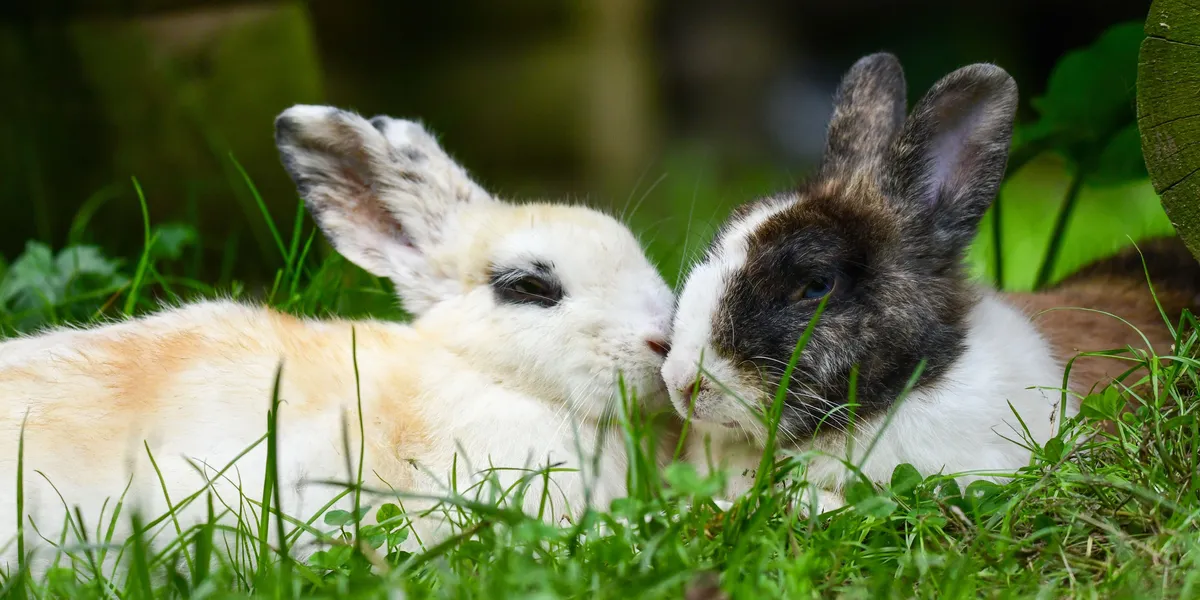
Watching a bonded pair is the clearest demonstration that rabbits are affectionate animals. They groom each other, lie pressed together, eat side by side, and follow one another around.
In the owner survey, 55.2% disagreed that rabbits are happy living alone. Rabbits are social animals, and many are noticeably better off with a companion.
It also carries a harder implication: bonded rabbits appear to grieve. When one of a pair dies, the survivor may go quiet, go off food, and search for its partner. Many vets and rescues recommend letting the surviving rabbit spend time with the body, which seems to help them understand the loss. Watch a grieving rabbit’s appetite closely — a rabbit that stops eating is an emergency regardless of cause. See why is my rabbit not eating.
Why this question matters more than it seems
Here’s the part of that 1,516-owner study that makes this more than a sentimental question.
The researchers found that owner perceptions predicted the care rabbits actually received:
- Owners who rated rabbits higher on emotions were more likely to provide a companion.
- Owners who rated rabbits higher on pain provided more enrichment variety and were more likely to use free-roam housing.
- Owners who rated rabbits higher on intelligence fed more appropriate diets.
And better positive welfare scores were associated with exactly those things — hay-based diets, varied enrichment, free-roam housing, and more time interacting with their owner.
In other words: people who believe rabbits have a rich inner life look after them measurably better. The authors suggested that improving owner perceptions of rabbit sentience may be one of the more effective routes to improving rabbit welfare generally.
So “are rabbits affectionate?” isn’t idle. Answering it accurately changes how rabbits get treated.
How to encourage affection
- Spay or neuter. The single biggest behavioural improvement available.
- Get on the floor. Rabbit relationships happen at ground level — see how to bond with your rabbit.
- Hand-feed herbs. Fast, reliable trust-building.
- Keep a predictable routine. Predictability is safety for a prey animal.
- Give them space. Confined rabbits are less sociable rabbits.
- Consider a companion, ideally an already-bonded pair from a rescue — or see how to bond two rabbits if you’re introducing one yourself.
- Never force interaction. Backing off when asked is what earns the approach later.
Frequently asked questions
Do rabbits love their owners? They form strong attachments and show consistent affiliative behaviours toward familiar people — grooming, seeking proximity, relaxing in their presence. Whatever we call it, it’s real and it’s directed at you specifically.
Do rabbits recognize their owners? Yes. They distinguish familiar people by voice, scent, and movement, and typically behave differently around a familiar person than a stranger.
Why does my rabbit ignore me? Often just timing — rabbits are crepuscular and sleep much of the day. Also check hormonal status, space, and whether past handling taught them that your approach means being picked up.
Do rabbits get lonely? Many do. Most owners in the survey disagreed that rabbits are happy alone, and a single rabbit needs substantially more interaction time from you.
Is my rabbit licking me a good sign? One of the best. It’s the grooming behaviour bonded rabbits use on each other.
Do rabbits miss you when you’re away? Bonded rabbits notice absence and often greet returning owners with obvious interest. Grief behaviour after losing a bonded partner suggests they register absence meaningfully.
Learn the vocabulary — binky, flop, chin, purr, lick — and it turns out most rabbits have been affectionate the entire time. They were never being distant. We were just watching for the wrong signals in the wrong language.
Source: ‘All Ears’: A Questionnaire of 1516 Owner Perceptions of the Mental Abilities of Pet Rabbits, Subsequent Resource Provision, and the Effect on Welfare, Animals, 2020.
← All posts