How to Bond With Your Rabbit: A Trust-Building Guide
A step-by-step approach to earning a rabbit’s trust, the signs it is working, and the well-meaning habits that quietly destroy it — including trancing.
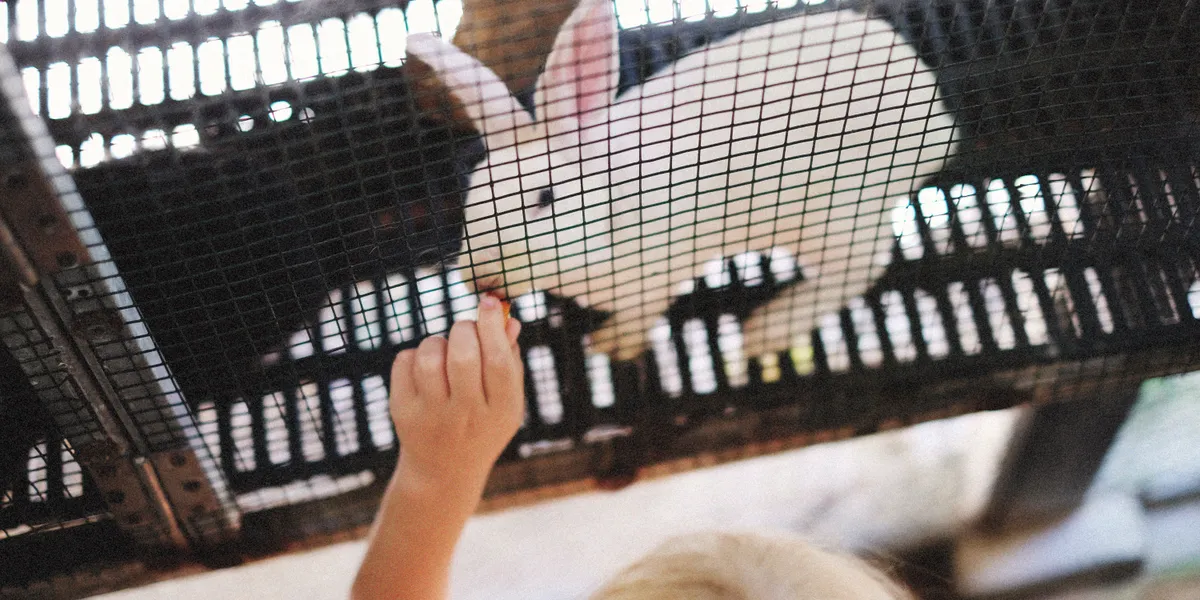
The fastest way to bond with a rabbit is deeply counterintuitive: stop trying.
Sit on the floor in your rabbit’s space, ignore it entirely, and let curiosity do the work for you. Bonding with a prey animal isn’t about winning it over with attention. It’s about becoming so safe and so boring that investigating you becomes the most interesting option available.
Done patiently, this works with almost every rabbit. Done impatiently — chasing, grabbing, hauling them out for cuddles — it can set you back weeks.
A quick note on terminology. “Bonding” means two different things in rabbit circles: building trust between you and your rabbit, and introducing two rabbits so they live together. This guide is about the first. For the second, see how to bond two rabbits.
Why bonding with a rabbit works differently
Dogs are social predators who evolved alongside us. Rabbits are prey animals whose entire behavioral repertoire is organized around not being eaten.
That changes what reads as friendly. To a rabbit:
- Looming from above is what an aerial predator does.
- Being picked up is what happens when something catches you.
- Direct, fast approach is what a predator does.
- A large creature lying quietly on the floor is, eventually, just furniture.
There’s evidence for how badly the handling instinct misfires. Owner surveys suggest around 60% of pet rabbits struggle when lifted, and fear-related aggression is common. Research reviews are fairly blunt that being picked up and held is unpleasant for most rabbits.
There’s a real tension worth naming: UK welfare research lists lack of handling and socialisation among the top welfare concerns for pet rabbits, while also finding that most rabbits don’t respond calmly to handling. The resolution isn’t more grabbing. It’s more time together at floor level, plus gradual desensitisation for the handling that genuinely has to happen — vet trips, nail trims, health checks.
Step 1: Do nothing, near them
Sit or lie on the floor in your rabbit’s space. Bring a book or your phone and genuinely use it. Don’t look at the rabbit, don’t reach for it, don’t talk to it much. Twenty minutes at a time, daily. Your job here is to be furniture with a pulse.
Your rabbit will approach eventually — first to sniff at a distance, then closer, then to nudge or climb on you. That first voluntary approach is the whole foundation.
If your rabbit hides the entire time, that’s still progress. You’ve been present and nothing bad happened.
Step 2: Get on their level
Never interact with a nervous rabbit from a standing position. Lie down, sit, or at minimum crouch low.
Approach hands from the side and low, never descending from above onto the head. A hand coming down from overhead reads as a bird of prey — it’s an instinct you can’t reason your rabbit out of.
Step 3: Let them come to you
This is the principle everything else hangs on, and it’s the one people break.
Don’t reach for a rabbit that’s moving away. Don’t corner one to pick it up. Don’t chase, even playfully. Every forced interaction teaches your rabbit that your presence means loss of control, and it takes several good sessions to undo one bad one.
Backing off when your rabbit backs off actually speeds bonding up, because it teaches them that approaching you is always their choice.
Step 4: Use food, strategically
Food is your shortcut, and hand-feeding is the single most effective trust exercise there is.
- Put a favorite green on the floor a little away from you and let them take it.
- Over sessions, place it progressively closer.
- Then hold it flat on an open palm resting on the floor.
- Eventually offer it directly from your fingers.
Fresh herbs — cilantro, basil, mint — work best. They’re low sugar, so you can use them daily without diet consequences, and most rabbits are enthusiastic about them. See healthy rabbit treats.
Step 5: Learn where and how to pet
Most rabbits enjoy being stroked in a fairly narrow set of places:
Usually welcome: forehead, between and behind the ears, cheeks, along the back.
Usually not welcome: chin, feet, belly, tail, and the underside generally.
The classic invitation is a head nudge — your rabbit pushes its nose under your hand or against it. That means “keep going,” or “start.” If you stop and get nudged again, you’ve been given instructions.
A rabbit that lowers its head flat to the floor while being stroked is asking for more, not cowering — read it alongside the rest of the body language.
Step 6: Build a routine
Rabbits are strongly habitual. Feeding at consistent times, letting them out at consistent times, and doing your floor sessions at a consistent time all build a sense of a predictable world.
Predictability is safety for a prey animal, and safety is the precondition for trust.
Step 7: Respect the no
Learn the signals that mean back off, and then actually back off:
- Turning away or moving off
- Ears pinned flat back
- Thumping — see why does my rabbit thump
- Grunting or lunging
- Freezing with wide eyes
- Boxing with front paws
Honoring these makes you predictable. A rabbit that knows “no” works on you will offer “yes” far more often.
What builds trust, and what breaks it
| Builds trust | Breaks trust |
|---|---|
| Sitting quietly at floor level | Looming or reaching from above |
| Letting them approach first | Chasing or cornering |
| Hand-feeding herbs | Grabbing to “get cuddles” |
| Backing off when asked | Pushing through a clear no |
| A predictable daily routine | Unpredictable handling |
| Petting the forehead and cheeks | Belly, feet, and chin handling |
| Leaving hiding places inviolate | Reaching into a hide to pull them out |
| Gradual carrier desensitisation | Trancing (see below) |
That last one on the left matters more than it sounds: never extract a rabbit from its hide. The hide has to remain a place where nothing happens to them, or it stops working as a safe space at all.
The trancing myth
You’ll see it recommended for nail trims and grooming: put the rabbit on its back, and it goes still and floppy, apparently relaxed and blissed out.
It isn’t relaxed. It’s terrified.
This is tonic immobility, and it’s been studied. McBride and colleagues found that rabbits placed in this state showed increased heart rate, increased respiratory rate, and elevated cortisol — the stress hormone. They displayed fear behaviors including widened eyes and flattened ears, and afterwards showed more hiding and less grooming than before.
The rabbits were fully aware of their surroundings the entire time.
Evolutionarily it makes sense: playing dead is a last-resort response for an animal that has already been caught, in the hope the predator loosens its grip long enough to allow escape. That’s the state you’re inducing.
For a bonding article this matters twice over — it’s distressing in itself, and it teaches your rabbit that being handled by you ends in the worst thing its nervous system can imagine. If someone recommends trancing for grooming, ask your vet about alternatives instead.
Signs your rabbit is bonding with you
Progress markers, roughly in order:
- Eating in front of you — an early, meaningful one, since prey animals don’t eat where they feel unsafe
- Approaching voluntarily, sniffing your legs or hands
- Nudging you for attention or to move
- Circling your feet (in a neutered rabbit this is usually affection)
- Chinning you — marking you with their scent glands as theirs
- Sitting near you without being invited
- Tooth purring while being petted — soft, light chattering
- Flopping over near you, which requires real confidence
- Binkying in your presence — a joyful jump and twist
- Grooming you — licking your hand or arm, one of the strongest signals there is
More on what these mean: are rabbits affectionate.
How long it takes
Genuinely variable. A confident, well-socialised young rabbit might approach you within days. A rescue rabbit with a bad handling history can take months.
The most common mistake is treating slow progress as failure and escalating — more handling, more forcing. That reliably makes it worse. Rabbits that come around slowly usually come around completely.
Two things that change the timeline more than technique:
Spay or neuter status. Hormonal rabbits are more territorial and less interested in you. Many owners report a distinctly friendlier rabbit a few weeks after the procedure.
A companion rabbit. A bonded pair is often more relaxed overall, and a confident rabbit can model calm behavior for a nervous one.
Special situations
Rescue rabbits with unknown histories. Assume a rough handling past and go slower. Let them set every pace.
Rabbits that were never handled young. Early socialisation reduces fear of humans, and rabbits that missed it start further back. It’s still very much achievable — just longer.
Children. Supervise, and set the rule that interaction happens at floor level with no picking up. This protects the rabbit and gives the child a much better relationship. See do rabbits like to be held.
Bonding two rabbits. Different process entirely — neutral territory, gradual introductions, careful supervision. Don’t apply this guide to it; see how to bond two rabbits.
Frequently asked questions
How long does it take to bond with a rabbit? Days for a confident rabbit, weeks to months for a nervous or rescued one. Progress is rarely linear, and patience outperforms technique.
Why does my rabbit run away from me? Usually normal prey behavior rather than dislike, especially if you approach from above or standing. Get to floor level, let them come to you, and check whether unwanted handling is teaching them to avoid you.
Do rabbits recognize their owners? Yes — rabbits distinguish familiar people by voice, scent, and movement, and many greet a familiar person differently from a stranger.
Should I pick my rabbit up to bond with it? No. Picking up is what most rabbits like least, and roughly 60% struggle when lifted. Bond at floor level, and separately desensitise to the handling that’s genuinely necessary.
My rabbit lets me pet it but runs when I stand up. Is that normal? Completely. Standing changes your silhouette into something much more predator-shaped. It’s not a regression.
Does my rabbit actually like me? If it eats in front of you, flops near you, chins you, or grooms you, then yes — those are things rabbits don’t do around things they’re afraid of.
Sit on the floor, bring herbs, and let your rabbit make the first move. It is slower than you want it to be, and it works better than anything else you could do instead.
Sources: McBride A et al., research on tonic immobility in rabbits, via Rabbits and Tonic Immobility, Rabbit Welfare Association & Fund; Bradbury AG, Dickens GJE, Appropriate handling of pet rabbits: a literature review, Journal of Small Animal Practice, 2016.
← All posts